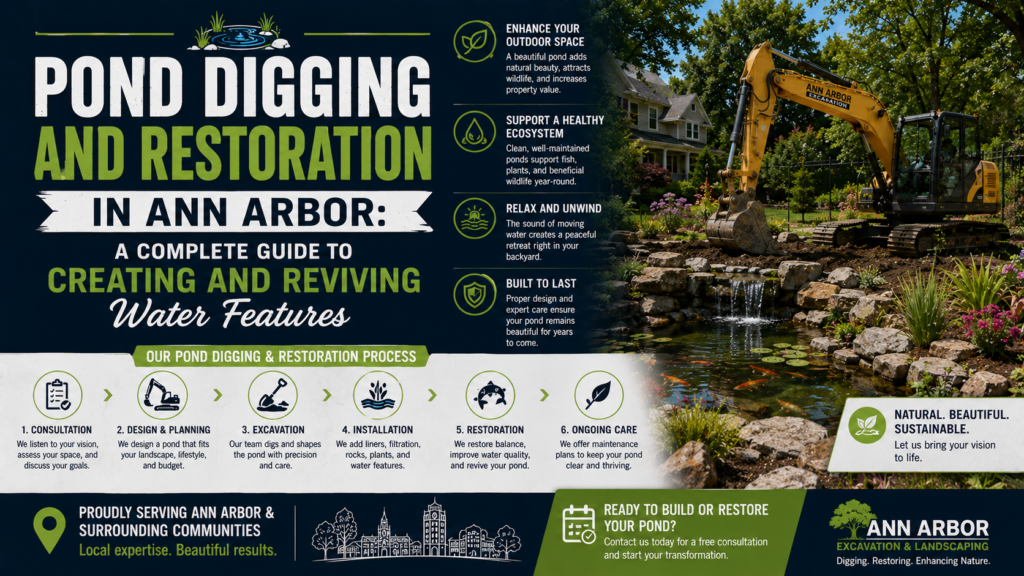
Water features have been a valued part of residential and commercial landscapes for centuries, and in Ann Arbor, the tradition continues. Whether a property owner wants to create a new pond from scratch or restore a neglected water feature to its former glory, the process involves careful planning, skilled excavation, and an understanding of Michigan’s unique ecological and seasonal conditions. This guide explores what Pond Digging And Restoration Ann Arbor actually entails, why it matters, and what property owners in Ann Arbor should know before undertaking such a project.
Why Ann Arbor Is Ideal for Pond Installation
Ann Arbor’s natural environment, including its proximity to the Huron River, its abundance of tree cover, and its four distinct seasons, creates a compelling setting for ponds and other water features. Michigan’s climate, while challenging in winter, actually supports rich aquatic ecosystems during the warmer months. Property owners who install ponds here often find them attracting local wildlife including birds, frogs, turtles, and beneficial insects like dragonflies, which help control mosquito populations.
The region’s soil composition, while presenting certain challenges for foundation work, can actually be advantageous for pond construction. Clay-rich soils naturally retain water, reducing the need for liner materials in some pond configurations, particularly larger agricultural or retention-style ponds.
What Pond Digging Actually Involves
Pond digging is the excavation and construction of a water feature designed to hold water permanently or seasonally. The process begins well before any machinery enters the property.
Site Evaluation and Design
The location of a pond on a property is one of the most consequential decisions in the project. Factors such as natural drainage patterns, sunlight exposure, proximity to trees (whose roots and leaf drop can complicate pond maintenance), underground utilities, and neighboring property boundaries all influence where and how a pond should be placed. Contractors conducting a site evaluation will assess the natural topography to determine how water will flow toward or away from the pond. In Ann Arbor, this also includes considering the city’s stormwater management regulations, particularly for larger or commercial pond projects.
Excavation and Shaping
The actual digging phase uses excavation equipment scaled to the size of the project. Small ornamental koi ponds in residential backyards might be excavated with compact machinery, while larger agricultural ponds, retention basins, or ecosystem ponds require full-size excavators. The shape of the pond is determined by the design plan, and most natural-looking ponds are dug with varied depth zones, shallow marginal areas for aquatic plants, mid-depth zones, and a deep section for fish to overwinter in Michigan’s cold months.
Liner or Clay Sealing
Whether a pond requires a liner depends largely on the soil type and the intended use. Sandy or gravelly soils require rubber or EPDM liners to hold water effectively. In areas with clay-dominant soil, compacting the base and sidewalls may be sufficient to seal the pond naturally. For decorative water features, pre-formed rigid liners or flexible membrane liners are commonly used, and choosing the right material affects both the longevity and the ecological function of the pond.
The Benefits of Installing a Pond
A well-designed pond delivers value on multiple dimensions. Aesthetically, a pond creates a visual focal point that transforms any landscape, introducing movement, reflection, and the gentle sounds of water. Ecologically, a pond supports biodiversity by attracting aquatic and semi-aquatic wildlife, creating habitat corridors in urban and suburban environments. Retention ponds and detention basins also play an important functional role in managing stormwater runoff, which is increasingly relevant in Ann Arbor given the city’s investment in green infrastructure.
Research also supports the wellness benefits of proximity to water. The sound of running water and the opportunity to observe aquatic life have been linked to measurable reductions in stress and improvements in overall well-being. For homeowners, a pond can also positively affect property value when it is well-maintained and thoughtfully integrated into the landscape design.
Pond Restoration: When a Neglected Pond Needs New Life
Many properties in Ann Arbor have existing ponds that have been neglected or that have declined in water quality, structural integrity, or ecological function over time. Pond restoration is the process of returning these features to a healthy and visually appealing state. It is a different undertaking from simply cleaning a pond, though cleaning is often part of restoration.
Drain and Assess
Restoration typically begins with a full drain of the pond. Once empty, contractors can inspect the liner for tears, punctures, or deterioration. The structural walls and base can be examined for erosion, settling, or other damage. The sediment and debris that have accumulated on the bottom, sometimes several feet deep in older ponds, can then be removed.
Sediment and Vegetation Management
Sediment accumulation is one of the most common problems in older ponds. Over years, organic material washes in, settles, and creates an anaerobic layer that depletes oxygen, encourages algae blooms, and degrades water quality. Restoration involves mechanically removing this sediment. Similarly, invasive aquatic vegetation, such as common reed or cattail monocultures, may need to be cleared to restore a more balanced plant community.
Structural Repairs and Reshaping
If the pond’s banks have eroded or its shape has changed over time due to soil movement, excavation equipment may be brought in to reestablish the original contours or to create an improved design. Bank stabilization using rock, native plantings, or bioengineering techniques is often incorporated during this phase. In Ann Arbor, native shoreline plants such as blue flag iris, pickerelweed, and various sedge species are popular choices for stabilizing pond edges while supporting local pollinators.
Seasonal Considerations for Ann Arbor Pond Projects
Timing a pond project appropriately to the Michigan season is important. Late spring and early fall are generally optimal for both new pond installation and restoration work. The ground is workable, soil moisture is manageable, and the weather is favorable for both equipment operation and plant establishment. Winter pond installation is possible but significantly more challenging due to frozen ground, and summer work in peak heat can stress any aquatic life that needs to be temporarily relocated during restoration.
Long-Term Maintenance After Installation or Restoration
A pond, like any landscape feature, requires ongoing maintenance to remain healthy and beautiful. This includes seasonal tasks such as removing dead vegetation in autumn, checking equipment like pumps or aerators before winter, performing spring inspections after ice-out, and managing algae and invasive plants during the growing season. Proper aeration is particularly important in Michigan ponds, as oxygen depletion under ice during long winters can result in fish kills. Understanding what a pond needs through all four seasons is part of what separates a thriving water feature from a problem-prone one.
Conclusion
Pond digging and restoration in Ann Arbor is a rewarding investment that connects properties to the natural character of the region. Whether you are creating something entirely new or breathing life back into a neglected water feature, the work requires skilled excavation, ecological awareness, and a thoughtful approach to Michigan’s seasonal rhythms. The result is a landscape feature that delivers beauty, biodiversity, and lasting value for years to come.